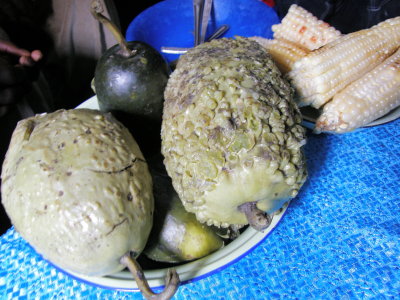
I just got back from a four-day-long village stay in Kabudula, about 40 miles into the bush from our home in Lilongwe. Four days of visiting people in their homes, being stuffed with foods I’ve never tried before, and speaking Chichewa. Rather than just try to describe everything with words, I thought I’d try with pictures, one per day until I run out of good ones.

What can a day’s salary buy in Malawi? The salary for a typical worker (like a public school teacher, a housekeeper, or a security guard) is in the neighborhood of 10,000 to 15,000 Malawian Kwacha per month, which works out to about four US dollars per day. Here are some pictures of what US$4 could buy: Continue reading “A Day’s Wage”
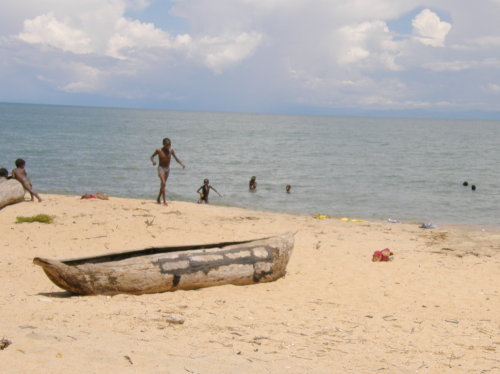
Over the Christmas break we stayed at a cabin that belongs to some friends of ours on Lake Malawi, away from the touristy areas. While it was good to spend a couple of days away from home, our time at the beach wasn’t what you would probably think of as a normal vacation experience.
Cervical cancer is the number one cause of cancer deaths in Malawi; not breast cancer, not lung cancer, not colon cancer, but cervical cancer which can be prevented by early detection and treatment of precancerous lesions on the cervix. Cervical cancer cases are much lower in developed countries due to screening, specifically with the Pap smear. However, Pap smears are not affordable and are not feasible in Malawi: there is only one pathologist to read them in the country and he is based in Blantyre. Visual Inspection of the Cervix with Acetic Acid (VIA) was developed previously by international healthcare providers as an inexpensive, effective way to detect precancerous changes in the cervix. If changes are detected, there are treatments available to remove the lesion to prevent it from developing into cancer. The Ministry of Health in Malawi is pushing for more VIA testing throughout the country.
Continue reading “Cervical Cancer Prevention”
Clang, clang..there was another person at the gate. This sound was becoming a usual occurrence; since arriving almost two months ago we have had many people coming to our gate: some looking for work, others wanting to sell vegetables or woodcarvings. That time, though, I was just tired and alone and did not want to go out to tell someone seeking a job that we had no work available at this time. I asked our guard what the person wanted and he stated he did not know because the man was Shona and did not speak Chichewa well. When I heard Shona, my ears perked up. As Peace Corps Volunteers, Dean and I had lived in Zimbabwe among Shona people and had learned Chishona, their language. I had to know his story.
Continue reading “The Poor at Our Gate”
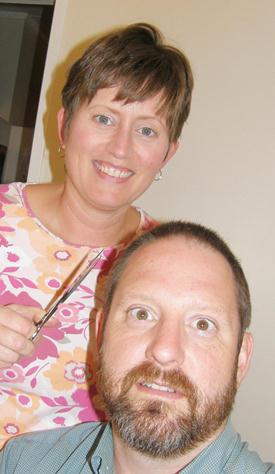
We laughed very hard at a mistake Dean made yesterday in our language lesson; I still get the giggles when I think of it. He was trying to tell our teacher that I cut his hair this past weekend. Since many of the words are similar between Chishona (which we learned in Zimbabwe) and Chichewa (the official language of Malawi), he decided to use the Chishona word for hair. Our teacher had a funny look on her face and said “Why is he telling me this?” After he explained in English what he was trying to say in Chichewa, she patiently taught us the three words Chichewa has for hair: tsitsi (hair on your head), cheya (hair on your arms and legs), and bvuzi (pubic hair, the word that Dean used). That explained her reaction! We had a good laugh and learned a valuable lesson about hair in Chichewa.



 The Stockers' Stories