I woke up late this morning, almost 6:00, to hear one of my neighbors calling “Odi” outside of my house. That’s how you call attention to the fact that you’ve arrived. No doorbells. And knocking would be rude, used only as a last resort. You stand in the yard outside the house calling “Odi…..Odi-odi…..Odi!…..ODI!” until somebody answers.
It’s Paul, a good friend, asking to borrow my car for a trip to town, since his wife is away for the week with their car.
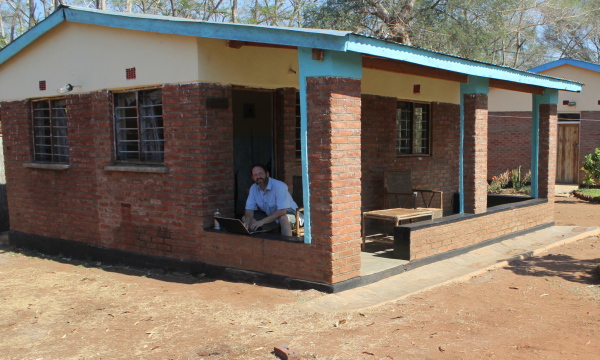
Two cups of coffee and a bowl of granola for breakfast, sitting on the khonde (porch) of “Moses House” where I stay on the farm, usually from Tuesday to Friday every week, while my family is in Lilongwe city. It’s Wednesday, which means that we have our weekly Kindle Orphan Outreach management team meeting.
A fairly typical management team meeting, 8AM to 11AM sitting in a poorly ventilated office with Yohane Chisale (Community Development Facilitator), Hestern Mbena (Head of the Education Department), Abusa Mbereko (Head of Spiritual/Social), Patience Mkandawire (Head of Health), and James Kabuli (Administrator / Finance Manager). Mostly just updates so everybody knows what’s happening–getting ready to teach several families a simple way to make compost; yesterday’s Youth Group & Family Life Group volunteers’ meeting went well; the women at Mayambo village will be sharing profits from their “banking khonde” village savings & loan on Saturday; a pair of orphaned twins were admitted to our Critical Care Facility on Friday, and should be able to return to the village by the end of the week–the smallest weighed 1 kg on Friday and is up to 1.4 kg today…
It’s funny writing about it now. It’s all very business-like, with bullet points and an agenda. But we’re talking about lives that are being changed. The compost will help to ensure that the 44 orphans in those 12 families have enough to eat next year. The Youth Groups and Family Life Groups are bearing fruit in more ways than I can begin to write in a blog article. The “banking khonde‘s” are teaching people to better manage what they have and giving opportunities for dreams to come true; last week I was at a meeting where I heard many testimonies of lives changed through these “banking khonde‘s.” And those twins would probably be dead today if not for the care that they received over the last week.
At every meeting there are decisions to be made. Some are (to me) laughable:
A local commercial farmer needs a few litres of water for his tractor. Can he use our tap?
Others are decisions about requests that we are constantly receiving:
The blind man who we helped to enroll in teacher training has a staff house now at a nearby school and his two dependents have come to live with him. They have no food and he likely won’t receive his first paycheck for several months. Can we help with food?
And sometimes there are staff and community issues that have come up and need to be dealt with:
Partly because of a culture-related miscommunication between myself and one of our valued employees, he and his family have moved so far away that he can no longer do his job unless we provide him with $400 worth of transportation per month. His gross salary is $140 per month. What should we do?
Paul is back from his trip to the city by the time the meeting is over, so I go to his house where he shares a meal of rice & chicken with me. I enjoy visiting with him because he has lived virtually his entire life in Malawi, and he often has a fresh perspective on people and happenings. And he’s just generally pleasant to be around.
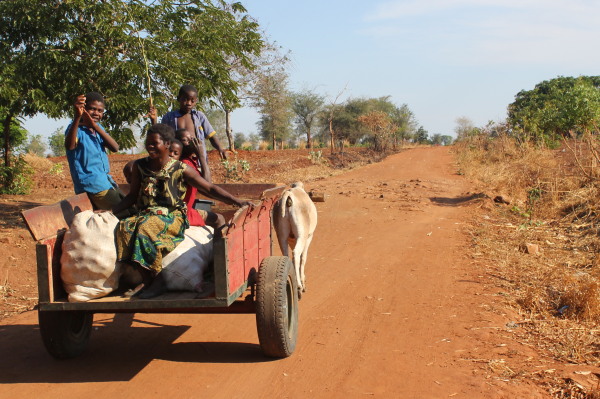
Walking is the most common method of transportation in our area, but a few people have oxcarts that they can use when they have too much to carry. This one is loaded with bags of mangoes that they are hoping to sell.
This is a bit unusual, but I have nothing planned for the afternoon. That gives me a chance to do something I’ve been wanting to do for over a year. I hopped on my bike and went to a youth group meeting unannounced. Typically when I visit a youth group they’ve known for a few days that I’m coming, so they have time to prepare. Which means that what I find looks more like a circus than a youth group meeting. There is a keyboard blasting out chords that match more or less with the various groups that come out singing, almost loud enough to drown out the sound of the generator that is running it. In the shadow of a tree there is a row of the best chairs from all over the village for me and whoever I happen to bring along. There are at least three leaders, either Kindle staff or volunteers. And since every person in the village has turned out it becomes more of festival than a youth group meeting. Which isn’t a bad thing to have, but what I really want to know is what a youth group meeting looks like when nobody’s watching.
I arrived at Namanda nearly two hours late, figuring that they probably would have started by that time. But I didn’t find anybody there. As it turns out, they were all most likely at the local government agricultural facility because today was the day that they were distributing subsidized fertilizer.
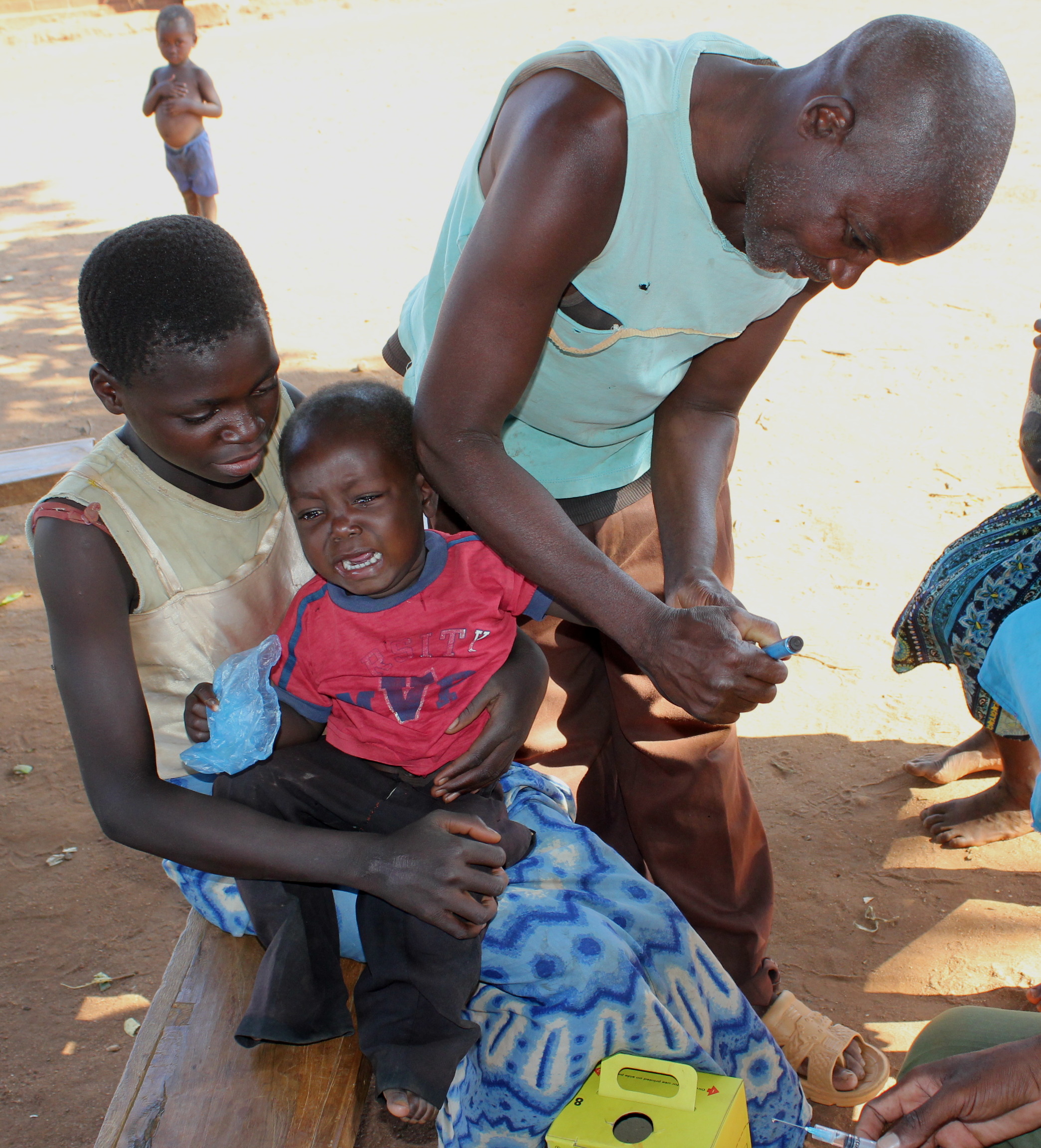 I came across some of the workers from our clinic while I was out exploring. This week is a measles campaign, so children were being vaccinated and also getting vitamins and de-worming pills. In this photo, they are marking the boy’s fingernail to show that he has received his shot.
The whole time I was out, I was passing people with 50kg bags of fertilizer strapped onto their bikes. Every year, the government gives out fertilizer coupons to farmers, which they can use to buy a $35 bag of fertilizer for $1.25. One older gentleman stopped to chat with me as he was biking along. When I asked if I could take a picture of him with his fertilizer he said that I would have to pay him to do it, which I politely refused to do. “Just enough for some soap,” he said, but still I wasn’t going to pay for the privilege of taking his picture.
At Kanzimbe village there was a group of young men playing bawo, a game that I used to think that I understood. It’s a bit like Mancala, where you move stones around in holes, trying to steal them from the other person. I was invited to play, but I declined because they were betting on the games and I didn’t think it would be a good idea for me to be involved in gambling! This is also something that I’ve been wanting to do for a long time, just going into villages to spend time with the men there. Most of what we do at Kindle targets women and children, who are usually the ones most in need of special care. But many of the problems faced by women & children originate with the men, so we need to have an impact there, too!
The sun was setting on my way back to the farm, but I did stop to speak with a woman who was working in a field, doing something I’d never seen before. She was picking up small rocks beside the road and putting them in a bucket. Nearby, her three- or four-year-old daughter had a crude sifting tool that she was using to pick rocks out of a dusty patch of soft dirt. They were making a pile of rocks that they hoped to sell to make money “so we can buy soap.” Two times in one afternoon I heard about the need for soap.
The rest of the ride home I was thinking about the soap-making projects that others in Malawi have recently helped to start, and was wondering if that’s something that we should be doing here. So many ideas, but how to sort the good ones from the bad, and how to find time & resources for the good ones?
A typical dinner: I bring “ndiwo” to eat with the night watchmen at Kindle. The ndiwo is usually tomatoes, an onion, and either eggs or a packet of “soya pieces.” They cook it up along with whatever ndiwo they have brought from home, and they make a pot of nsima (thick maize porridge). We sit and chat a bit, and then I go to one of the offices and work on my computer for an hour or two before going back to Moses House to bed.




 The Stockers' Stories
Leave a comment