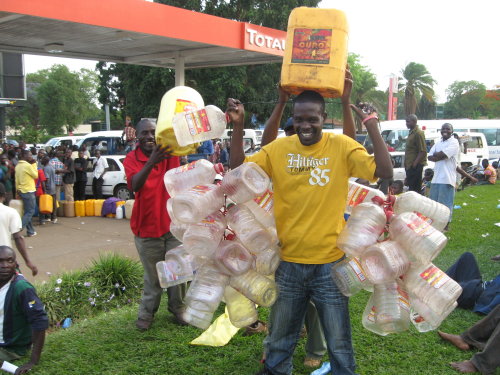
Malawi has a well-deserved reputation as the “Warm Heart of Africa.” Just yesterday I was looking for a shop in town, and asked someone who was sitting at the side of the road for help. As it turns out, I was only a block away, and he pointed me in the right direction. I thanked him and started to head off, then he got up and walked with me, to show me exactly where it was. When it was in sight, I thanked him again, but he kept walking with me. He took me all of the way into the store and showed me where the manager was, in case I needed to talk to him. People cheerfully help strangers here, often going well out of their way to do it. But lately we’ve been seeing another side of Malawians–shouting at each other, angry arm gestures flailing out of windows, pushing and shoving others aside.
The fuel crisis continues to worsen here. At the moment I’m sitting in a filling station queue with nearly 100 other cars, having arrived here before 6AM in the hopes that a tanker may arrive today. I was at this same station before 4AM last Tuesday, acting on a tip that fuel would arrive, but it didn’t. The truck I was sitting behind on Tuesday is still there, waiting. At least he knows that if fuel arrives he will get some. We have waited in queues five or six times in the last week and a half, failing to receive fuel every time. Either the tanker never comes or else they run out of fuel before we can get to the pump. At this point, the fuel gauge is in the red, all of our reserve fuel is gone, and we’ve logged over 30 hours trying to fill the tank.

And a lack of fuel is more than an inconvenience–for many it is having devastating effects. The rainy season is coming, so rural farmers need to have seed and fertilizer delivered, but deliveries are delayed for lack of fuel. There is already a shortage of many drugs in the country, but for rural hospitals the problem is compounded because of inability to transport the drugs that are available. At Kindle’s Katawa clinic, the ambulance is only able to make limited runs to the district hospital, so some people who we had been helping now have to try to find their own way into town for medications or procedures.
The fuel problem is compounded by electricity “load shedding” that is happening right now–most places are without electricity for 6-12 hours every day. Our house in Lilongwe happens to be on the same electrical circuit as the State Guest House, which has been occupied by VIP’s for the past month, so we almost never suffer outages, but when I go to Salima to work at Kindle, power is a real problem. This week, power was out from 9AM to 8PM. Last week, it was out from 5AM to 10PM, except for 45 minutes in the middle of the afternoon. If there’s no electricity, many people and most businesses run generators, which exacerbates the fuel problem. Penny heard on the news Thursday that three women died in childbirth at a district hospital because there was no electricity and no fuel to run a generator when they needed advanced procedures. And when there’s no electricity, filling stations can’t pump fuel, even if they do have it.
There is another unfortunate side effect to severe power cuts: water. The city pumps run on electricity, so there are regular water outages. At our house we have our own private water tower, so we haven’t experienced the problem ourselves, but our night guard has started bringing a 5 gallon drum to our house daily to fill it with water because the only spigot in his area of town is dry every day except for an hour or so in the middle of the night.
All of this adds up to a lot of angry people, pushing and shoving to get what they can, when they can. Just before the fuel ran out at a filling station on Monday, a Malawian commented to those around him, “Ah Malawi, not the Warm Heart of Africa any more.”
Footnote: I’m home now. Failed again to get fuel after waiting for another seven hours. That puts us well on the way to 40 hours trying to fill this tank.




 The Stockers' Stories
Leave a comment