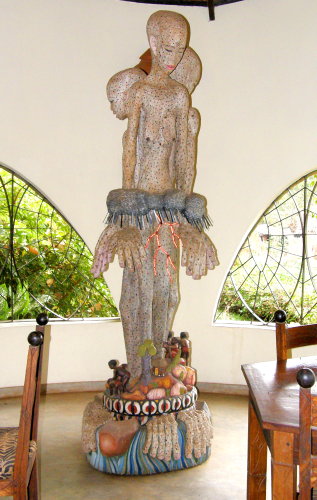
One of the first and most prominent pieces of artwork that we came to at Mua Mission is a statue of “Protective Spirits of Namalikhate,” made by local artist Thomas Mpira.
Namalikhate is a place of great significance for the Chewa people. This is where the ancestral spirits used to come to the river and wash their clothes, using the naturally formed “washing pots” carved and shaped into the rock over time.” (KuNgoni: When Water Falls Sand Becomes Crystal, Fr. Serge St-Arneault, MAfr, (c) 2007, p. 61)
Villagers, then and now, believe that protective spirits are present at this particular rock formation, seen by the waterside….The spirits would linger, if not disturbed, but at the slightest intrusion they would gather their clothes and be gone unseen, the stuff of rumour….[In this sculpture,] the invisible spirits emerge from pots as white and elongated human shapes. White is the colour of the spirits. They rise, surpassing the sky and piercing the dark rain clouds. They bring downpours with lightning, thus mingling with God-Chauta, the rain giver in Chewa culture. (Kungoni, p. 79)
This type of work is the focus of KuNgoni Cultural Centre at Mua Mission, and we are here because we are fascinated by the different views of the world that people have.
Father Claude Boucher Chisale, the founder of KuNgoni Cultural Centre, immersed himself into the local culture, even going so far as to join the Gule Wamkulu society, and to reconcile traditional Chewa beliefs with Catholic theology.
As Lord of the sky, God is transcendent, altogether different from any other being….He/She is the great one, not seen by man, but who, in the secret of the universe, listens to the prayers of the people….Christ’s role [is] as the first mediator over and above the ancestral spirits. Because of His/Her transcendence, God cannot deal directly with humans, as this would be seen as a breach of the politeness code of the Chewa society…Therefore, like the king in the territory, or the chief in the village, He/She must be approached or addressed indirectly, through the intermediary of the spirits. (The Gospel Seed: culture and Faith in Malawi as expressed in the Missio Banner, Fr. Claude Boucher Chisale WF, (c) 2002, p. 13)
I am not a Catholic and I am certainly not an expert in Catholic theology, but my understanding of it is that God the Father is so holy that He can not be approached by sinful man. So Jesus is an intermediary between the Father and men. But Jesus himself is also too holy to be approached directly, so there are other intermediaries between Jesus and men. In my understanding the Saints, Jesus, Mary, the Pope, Cardinals, Bishops, and priests are all seen to serve in one way or another as intermediaries between God and men. With this understanding, I believe that what Father Boucher is saying is that Chewa ancestral spirits can act as intermediaries between God and man in a similar way.
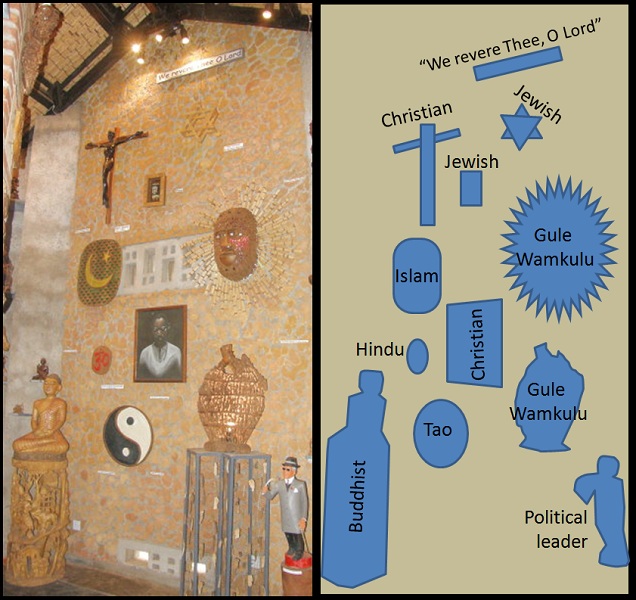
Based on this display in their art gallery, it seems that the world view presented at KuNgoni Cultural Centre is that all paths, including Gule Wamkulu, lead to the same God.




 The Stockers' Stories
Leave a comment