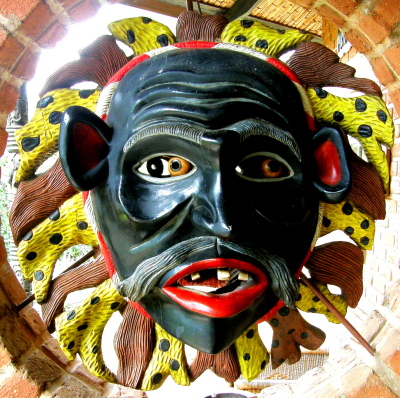
We (without our kids) spent a couple of days this week at a cultural centre learning about some of the peoples of Malawi. We spent most of our time studying the Chewa, which is the largest ethnic group in Malawi and is dominant in the Central Region where we live. It was a thought-provoking experience.
We have a few pictures from the cultural centre, but not nearly as many as we would have liked to have taken. Photography is forbidden in the room where we spent almost all of our time, because of an agreement with the local chiefs. That room contains over 400 masks used in Gule Wamkulu, “The big dance.” These dances are performed by members of the Nyau society, a secretive group whose function is to pass on Chewa traditions through interactions with the spirit world. When the Nyau dancers put on the “masks,” which often cover the entire body, they are no longer themselves, but they become the spirit represented by the mask. The dances are morality plays that teach the history, values, and traditions of the Chewa people.
I would like to share bits and pieces of what we saw and learned.
A good place to start is probably with Chadzunda and Mariya.
Chadzunda is head of the spirit world and embodies the chief of the community, as well as the world of the ancestors. He represents law and order. He brings people together by giving his wisdom and by stressing the rules laid down by God-Chauta. The Chadzunda character is the most ancient and most prominent of all masks of the Gule Wamkulu. He is the progenitor of all other Gule masquerades. Similarly, Mariya is the mother of the Gule as well as the mistress of girls’ initiation…. Although the Chadzunda character limps and appears frail at the beginning of his performance, he actually embodies the mwambo [culture and traditions]. When dancing, Chadzunda shows tremendous energy, demonstrates the vigour of his leadership and the power of his mediation with regard to rain and fertility. (KuNgoni: When Water Falls, Sand Becomes Crystal, Fr. Serge St-Arneault, MAfr, (c)2007, p. 76)

Mariya represents a mzimu [spirit] that is tenderhearted like a woman. There is no cruelty in this mzimu, only goodness….[The dancer] dances well and his dance is meant to make people happy. It is said that this figure and its name have been copied from Christianity (Maria, the mother of Christ). (Chewa Traditional Religion, J. W. M. Van Breugel, (c) 2001 by CLAIM, pp. 160-161)
The chief requests the characters of Chadzunda and Mariya to dance during puberty rituals, to portray the rules of marriage and fertility. They represent a successful couple: considerate, faithful and creators of many children. (KuNgoni, p. 76)
It is interesting to note that the character Mariya is taken from Christian tradition, while opposition to Gule Wamkulu has been the position of the church for almost all of the history of Christianity in Malawi. And it’s also interesting that (in my understanding) the Catholic church, which runs this cultural centre, teaches that Maria remained a virgin for her whole life while for the Gule Wamkulu she represents fertility and has many children. There seem to be some disconnects somewhere!




 The Stockers' Stories
Leave a comment