Words
The left columns of this book generally contain verbal representations of physics.
Physics is an attempt to describe the behavior of the physical universe. But the universe is complicated, so it is necessary to make some simplifications.
The approach of this book is to start out by looking at the behavior of very simple objects, and gradually move to more and more complicated systems. An “object” in physics can be anything that doesn’t change shape. A “system” is a collection of one or more objects.
We will start with the area of physics that is called mechanics. There are four main concepts involved in mechanics: motion, momentum, energy, and force.
Pay attention to the color coding. The words, graphics, and numbers are color coded to help show which concept is being considered and how the concepts are interrelated.
Motion is important because it is what we can most directly observe. This includes the object’s position; its velocity, which is another way of saying its speed and its direction of motion; and its acceleration, which is the change of an object’s velocity over time.
Momentum is related to the effort that would be needed to stop a moving object. This physics definition overlaps well with the way the word “momentum”
is used in our everyday language. If you own a successful business we say that it has momentum,
and your competitors will have a hard time stopping you!
In physics, momentum increases with an object’s velocity and its mass. Velocity and momentum
share the same color in this book because of their close relationship to each other.
Energy is the capacity of an object or system to affect another object or system. It is closely related
to the idea of “work,” which is a transfer of energy into or out of a system by something external to that system. These physics definitions overlap well with the way the words “energy” and “work” are used in our everyday language. If you have no energy, you can’t do any work!
There are several different forms of energy, often associated with an object’s velocity, an object’s position, or an object’s temperature. Energy is able to transform from one form to another through various physical processes.
A force is an interaction between objects, often described as a “push” or a “pull.” Forces cause changes in motion, momentum, and energy, so forces are truly the heart of physics. All the grand theories of physics seek to study the forces that are at work in the universe.
Graphics
The center columns of this book generally contain graphical representations of physics.
Photos or Drawings
Motion Maps

Momentum vs Time Graph

Energy Bar Graphs

Force Diagrams

Numbers
The right columns of this book generally contain mathematical representations of physics.
A letter or symbol in italics is a variable used to describe some physical quantity. The same letter will always represent the same type of quantity. A lower-case 
because it has a size (magnitude) but no direction.
A letter or symbol with a half-arrow on top, like 


Boxed equations are true except for any limitations described in the accompanying text.

Unboxed equations are true for a specific example but are not generalizable to all situations.
Motion is described by position 

Note that all of these physical quantities are vectors.
The symbol for momentum is 

(1.1)
Note that momentum is a vector. It always points in the same direction as the velocity
.
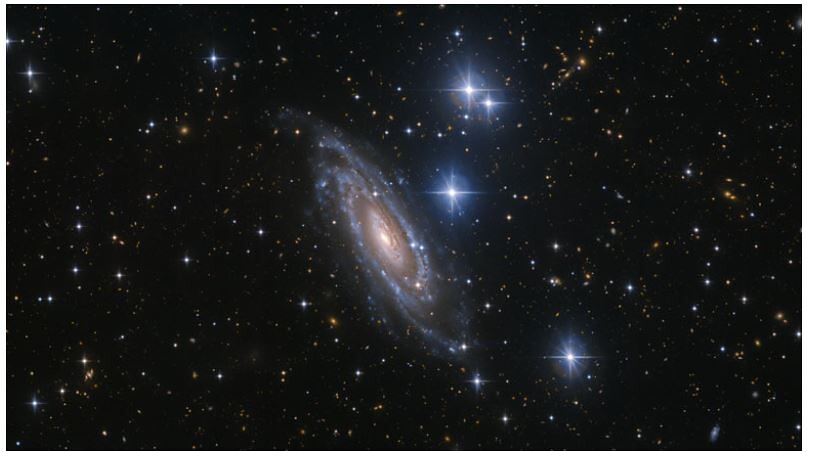
- Catalog Galaxy NGC 1964 by tonynetone is licensed under CC BY 2.0 ↩︎
- Original image created by the author ↩︎
- Original image created by the author ↩︎
- Original image created by the author ↩︎
- Original image created by the author ↩︎




 The Stockers' Stories